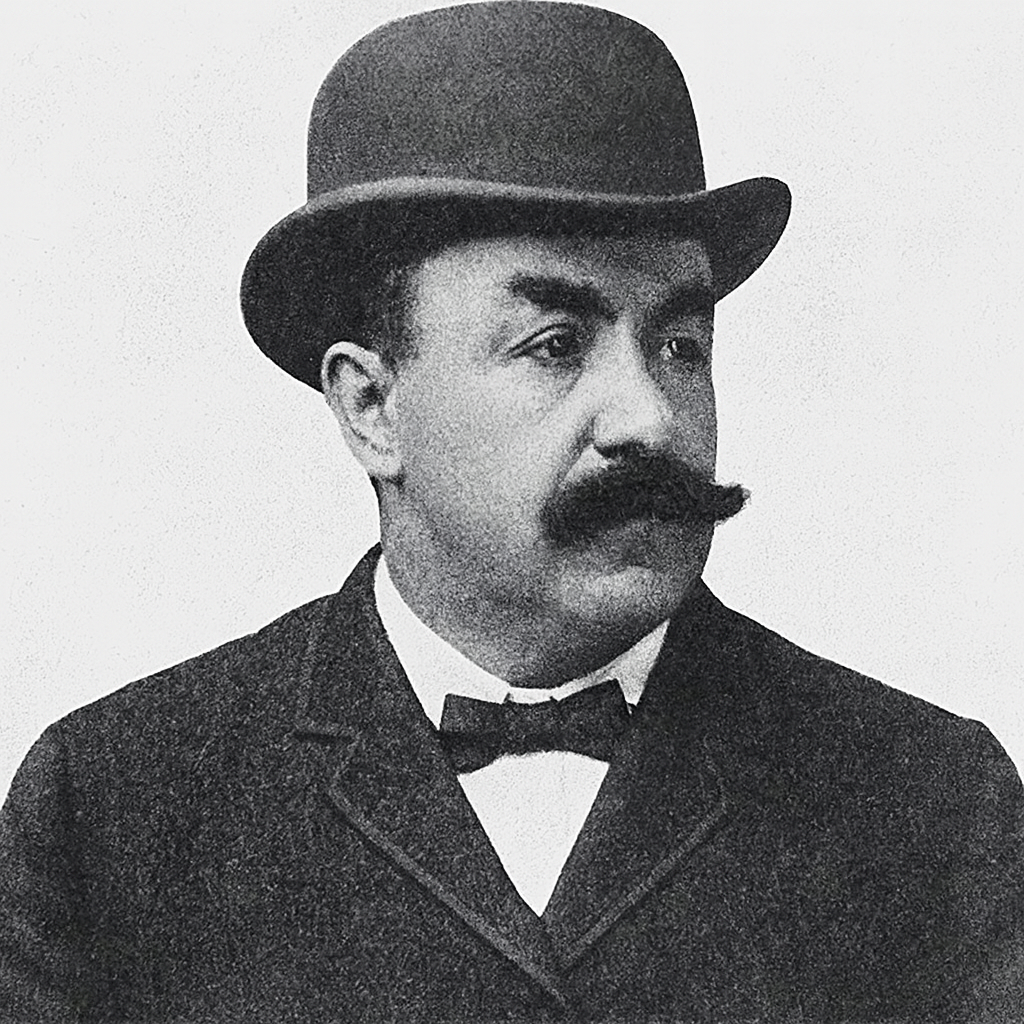
Philadelphia Police Department
approx. 1874 – 1900
The Real Detective Behind Frank Geyer in the Devil’s Shadow
Before he became the central figure in Frank Geyer in the Devil’s Shadow, Frank Geyer was a real man—a working detective known to newspapers as “America’s Sherlock Holmes”—navigating the darkest corners of America at the end of the 19th century. Long before forensic labs, criminal databases, or national police networks, Geyer hunted criminals with nothing but paper records, memory, witness statements, and relentless persistence.
His ability to trace fugitives across cities, states, and even international borders earned him a reputation few real detectives ever achieve. Newspapers across the country would come to call him “America’s Sherlock Holmes”—not for theatrical flair, but because, like the fictional Holmes, Geyer solved crimes through logic, documentation, and tireless reconstruction of truth.
A Young Detective in a Growing City
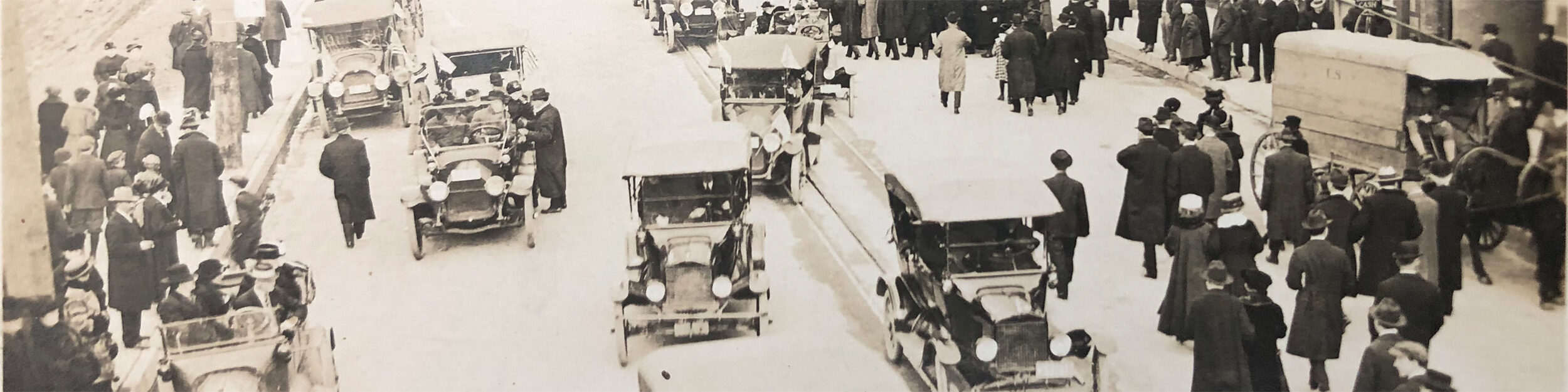
Frank Geyer was born in 1852 in Philadelphia to German immigrant parents. He grew up in a city exploding with industry, railways, and immigration. Opportunity and crime rose side by side, and law enforcement struggled to keep pace.
Geyer joined the Philadelphia Police Department in 1876. He began his career on routine patrols, where he quickly distinguished himself not through physical dominance or bravado, but through meticulous record-keeping and an uncommon memory for detail. Supervisors noticed that Geyer could recall names, locations, and timelines long after others had forgotten them.
By the 1880s, he had earned promotion to detective. His specialty became reconstructing movement from fragments—hotel registers, railway tickets, shipping logs, and ledgers most men overlooked. This skill would eventually make him famous.
The Losses That Shaped Frank Geyer
One of the most defining sequences of loss in Geyer’s life unfolded not through violence or crime, but through illness and grief within his own home. His wife died from tuberculosis—a slow, wasting disease that was tragically common in the late 19th century and often fatal despite every available treatment. The drawn-out nature of the illness transformed his private life long before it took her life, replacing certainty with waiting and dread.
The loss alone would have been devastating. But it was followed by an even deeper blow: the later death of his young daughter. Historical records offer little medical clarity, but there is no question about the emotional weight of the double loss. Together, these two deaths dismantled the personal world Geyer had built and permanently reshaped the man he would become.
Those who worked with him afterward observed a quiet but unmistakable change. Geyer grew more reserved, more inward, and increasingly willing to accept long, exhausting investigations that kept him separated from whatever fragments of home remained. In an era when public grief was rarely acknowledged—especially among working men—he buried his sorrow beneath routine, repetition, and relentless focus.
Many historians believe that the compounded nature of his losses—the slow decline of his wife followed by the sudden absence of his child—sharpened Geyer’s empathy for suffering and disappearance alike. He did not merely understand loss as an event, but as a presence that lingered. That understanding would echo through his later work, particularly in cases involving missing children, fractured families, and unresolved vanishing acts.
The Birth of Long-Distance Criminal Tracking
At a time when most detectives worked strictly within city limits, Geyer became one of the earliest pioneers of interstate criminal pursuit. There were no centralized law-enforcement systems. Communication between departments relied on telegrams, handwritten letters, newspapers, and face-to-face meetings.
Tracking a suspect across state lines meant weeks—or months—of physical travel by train and carriage. Geyer mastered the art of paper-trail reconstruction. He learned to trace aliases through handwriting comparison, follow fugitive routes through railway logs, and cross-reference witness accounts across entire regions.
This ability was almost unheard of at the time—and it became the foundation of his enduring reputation.
Why the Newspapers Called Him “America’s Sherlock Holmes”
The nickname did not come from Geyer himself. It was coined by journalists who saw in his work the same principles that made Arthur Conan Doyle’s fictional detective famous: deduction, patience, and logic.
Geyer relied on documentation above instinct. He pieced together scattered evidence across jurisdictions. He worked alone for long durations. He conducted interviews with remarkable restraint and rarely rushed to judgment.
Unlike the fictional Holmes, however, Geyer did not stage dramatic public reveals. His conclusions were built quietly through records, travel logs, and physical verification. His fame came not from spectacle—but from results.
The Case That Made Him Nationally Known
At the height of his career, Geyer was assigned to pursue a fugitive whose crimes would shock the nation. That investigation—connected to the infamous H. H. Holmes—required him to track movements across multiple cities, states, and even into Canada.
Over the course of months, Geyer reconstructed a complex web of travel through hotel records, shipping registers, railway tickets, and witness interviews. The pursuit culminated in one of the most significant criminal resolutions of the late 19th century and permanently established Geyer as a national figure.
While Frank Geyer in the Devil’s Shadow reimagines this pursuit through a noir lens, the real investigation reshaped the public’s understanding of what a detective could accomplish—and how far justice could travel.
Grief, Discipline, and an Unusual Mind
Those who worked beside Geyer described him as calm under pressure, emotionally restrained on duty, unwilling to rush conclusions, and intensely focused on precision. His grief only deepened these traits.
He trusted documentation more than emotion and structure more than instinct. In doing so, he developed an investigative style that feels startlingly modern—closer to criminal profiling and behavioral reconstruction than 19th-century policing.
His investigations demanded physical stamina, isolation, psychological resilience, and continuous reasoning under uncertainty. His work was not heroic in the romantic sense—it was exhaustive, grinding, and emotionally costly.
Writing, Retirement, and a Quiet End
After completing the case that made him famous, Geyer remained with the Philadelphia Police Department for several more years, retiring in 1903. Inside law enforcement, he became known as a specialist in extended, document-heavy investigations.
In an unusual decision for the time, he later wrote and published a book detailing one of his major cases—not as sensational entertainment, but as a professional record of investigative method. It stands among the earliest firsthand works by an American detective explaining the mechanics of large-scale fugitive tracking.
After retiring from the force, Geyer withdrew from public attention. He did not cultivate fame. He did not lecture. He did not seek legacy. He died quietly in 1918.
Frank Geyer’s Legacy
Today, Frank Geyer is remembered as one of the most important detectives of the 19th century—a pioneer of interstate criminal pursuit and a master of deductive paper-trail investigation. He bridged the gap between local policing and national criminal investigation at a time when no such system existed.
He worked without forensic science.
Without centralized records.
Without rapid communication.
And yet, he succeeded.
The Man Behind the Shadow
What ultimately separates Frank Geyer from fictional detectives is not brilliance alone—but endurance. His greatest tool was not intellect in isolation, but the ability to apply it continuously across distance, uncertainty, and exhaustion.
He did not chase mysteries for amusement.
He chased resolution for the living—and accountability for the dead.
All while carrying the private burden of grief that shaped his every pursuit.
This biography is a prelude of the upcoming novel, “Frank Geyer in the Devil’s Shadow“.
Join the mailing list to get early chapters, launch updates, and exclusive bonus material.
You can easily unsubscribe at any time from this link.